Monday, July 11, 2016

16 Bullets from Podcast Movement 16

There’s nothing like spending two days with people who are “over the top” passionate about something.

In this case that something was podcasting with the excitement surrounding it on display at “Podcast Movement 16” in Chicago this past Thursday and Friday.

Some of our radio clients and friends have been asking questions like:

Is podcasting a “thing?” (Yes).

Are there revenue opportunities? (Yes, there are many - though they may be different than ones you’ve been considering).

Will it build my brand and my relationship with my listeners? (Yes, if it becomes a “must hear” – and that’s not easy).

Will it bring me higher ratings? (Maybe – it could introduce the station or talent to new listeners or it could give you another edge over a competitor. Again, it depends on the strength of the creative as well as other factors like focus and deadlines).

While radio attendees were clearly in the minority, the convention offered our industry ample food for thought - especially when it comes to jumping in.

Here are 16 bullets from Podcast Movement 16 that are worth considering in today's on-demand environment (comments paraphrased):

  1. Define the show with 300 words; use this to pitch the show and to keep it focused as you execute it.  (Anna Sale, “Death, Sex and Money” podcast)
  2. 35-million people over the age of 11 have listened to a podcast in the last week; that’s 12% of the US population. Among (Edison Research) diary keepers who listened to a podcast on the day they kept a diary, their podcast listening accounted for 32% of all their listening that day.  (Larry Rosin, Edison Research)
  3. What content marketing is supposed to be is solving a problem that your business solves.  Through your podcast, prove that you’re s passionate about solving the sample problems the listener is. (Jay Acunzo, Traction)
  4. Most commercial broadcasters haven’t jumped in because music radio doesn’t lend itself to podcasting. However many morning shows have a feature which listeners would like to time shift. A podcast is about a show. Radio is about a format. There’s a conflict between the show concept and the format concept. NPR already knew how to make shows. (Larry Rosin)
  5. “It’s an incredibly robust time to be in the audio business…if you put out good content, you’re going to find a pathway to someone’s ears.” (Traug Keller/Sr. VP ESPN Audio)
  6. We do good audio content and let it flow to the various platforms. That decision left us free to be a multi-platform entity. (Traug Keller)
  7. As dynamic ad insertion increases, many different products will emerge. There will be shows created for ads that will command a premium dollar. (Sara Van Mosel/WNYC, Acast)
  8. Less than 1% of all podcasts come from radio. (Steve Goldstein, Amplifi)
  9. The vast majority of listening to pure plays is about 75% via the phone. For broadcasters, it’s now 50% on the phone. There’s going to be more phone consumption because there are more opportunities. (John Rosso/Pres Marketing Dev Triton Digital)
  10. Scale doesn’t have to be about thousands, but about fifty or a hundred. (Erik Harbison, Aweber)
  11. Build an audience that loves what you talk about, then sell them your solutions to their problems (Tim Paige, Leadpages)
  12. When it comes to monetization, “many streams make a river.”  Grab a little money every month from different sources. (Aaron Mahnke, @amahnke; creator of “Lore” which is a very successful podcast that is now headed to TV)
  13. CPM goes away when you’re doing local. (Rob Walch, Libsyn)
  14. When they advertise on podcasts, local businesses don’t need to spend a lot of money on production; they just have to talk to you. (Bryan Moffett, NPR)
  15. The Spanish language podcast audience is under-served. (Mignon Fogarty, Quick and Dirty Tips, Grammar Girl)
  16. Always remember you’re forming a relationship.  (Anna Sale)

.
As Forbes noted this spring, “…podcast content lives alongside music.  This is important to note, as it means users with no deliberate intention of seeking out podcast content will now encounter it…”

As an industry, we have some of the greatest talent and story tellers in the world who deserve to be “encountered” on the podcast platform as well. 


Sunday, June 26, 2016

Remembering the Great Dan Daniel: Six Principles Behind the Success of One of America's Premiere Air Talents


Dan Daniel was one of the great air talents in America, being a standout in New York City for 42-plus years before he passed last week all too soon at 81.

With minor edits, this is a piece I wrote at the end of 2002 when, while still at the top of his game, “Dandy Dan” chose to retire from doing a daily show. At the time I wanted to share some of what I believed to be pillars of success of one of America’s best talents.  Now I’d like to share them again as part of Dan’s legacy: a gift to everyone who puts their heart into their work every day – because that’s what Dan did.

Thanks, Dan for the joy you gave us through the years on the air... and off the air for the priceless gift of friendship.

Miss you, “Trip.”
_____________________________________________________


For 42 years he'd been "king of the hill, top of the heap, a-number one" in New York, New York. 

WCBS-FM midday host Dan Daniel (5th from left), one of America's greatest talents and a fixture in New York City radio for 42 years, chose to relinquish his daily show Tuesday while still at the top of his game.

The effect will be as impossible to ignore as a person with a missing front tooth.

Dan left an indelible mark on me during the nearly five years I was privileged to be his Program Director at WYNY-FM in New York City. In the 11 years that have passed since then, I've thought a lot about the things that made Dan such a great talent (they're also what make him a great human being). I've distilled that rather long list down to six principles I believe not only contributed significantly to Dan's incredible success but also helped define him as a person.


Put your heart in it.

Dan never sounded like he wished he were anywhere but on the air. Every show was like a gathering of close friends who you were truly glad to see, and it was only when Dan was there that the get-together was complete.

No one knew this better than listeners. They'd call. They'd write. They'd show up at remotes to see him even though it may have taken them hours to get there and even though they'd already met him dozens of times before.

And they'd tune-in faithfully. Dan's daily passion for his show became our daily passion for listening. We loved listening to him because we knew he loved being with us – which is pillar number two.


Love your listeners.

Early on I concluded that Dan loved his listeners just about as much as they loved him. And like any relationship, he worked at keeping the bond strong.

He tuned in to what was important to them and paid attention to what they said.

He was patient with them, faithfully answering the same questions they'd been posing for years ("Hey Dan - who's size 9?" referring to his sign off "Love you all especially you size 9." With a hearty laugh, Dan always said, "My wife thinks it's her!") with such genuineness and enthusiasm that you'd swear it was the first time in his life that anyone cared enough to ask for his input.

Dan made it a point to seek out listeners at appearances - not that this was necessary. Listeners would have found him even if he tried to hide. One time when the Marlboro Country Music Show was in New York, I accompanied Dan as he worked nearly all of Madison Square Garden. It went on for hours! Every smile from Dan was genuine, every handshake an appreciative "thank you" for listening.

Simply put, Dan Daniel made people feel special. He made them feel as if they were the only ones in a sea of thousands. He made them feel that in fact it was he who wanted to spend time with them, not the other way around.

And it was the same way when you listened. Dan's cume may have been a quarter-million, but on my radio it always seemed like it was just Dan and me.


Be an observer.

Dan could research anything for his show and regularly did, but his greatest content was more often rooted in the things he saw around him, what he thought about those things, and how those things made us all feel.

"All" and "feel" are key words.

When I'd go with Dan to an appearance, I could count on hearing listeners recite edited versions of Dan's breaks. They'd wait in line to retell Dan something they'd heard him say perhaps months earlier - and then often they'd remark that when they heard it, they were just thinking or feeling the same way. These weren't soapboxes or rants they recalled, but Dan's observations and brief asides on life that cut through the noise of New York and found a home in listeners' hearts and memories.

What seemed to come so naturally and effortlessly for Dan is, in fact, a skill not easily mastered.  But Dan had it honed and perfected, the result no doubt of a lifelong practice of observation, being in the midst of listeners whom he well understood, and weaving these moments into stories and points-of-view.


Paint local pictures

Think it's hard "being local" where you are? Try it in New York with over 14-million people 12+ and 20 metro counties. Dan did it with word snapshots of neighborhoods, by referring to products by their local brand name rather than their generic categories, and by using New York-isms as naturally as any native (which Dan wasn't).

Dan talked the way we talked (albeit with a slight drawl sometimes) and talked about what we were talking about.

He rooted for the home teams, always using just enough information to let you know he was a fan like you. But Dan talked less about the score or facts you could find out anywhere. Instead, Dan helped you experience the fans' reaction when Bernie hit the game-winner. He'd let you feel what it was like on the subway there and back.

Dan painted accurate pictures because he knew his market and his listeners so well.


Be real

Dan was always "one of us." His words and attitude let you know he was your fellow commuter and your walk-to-work-pal, trudging through slushy winters and sweating through sticky summers.

For years he defined afternoons in New York, and drives home on the Turnpike, the L.I.E., the Sawmill, the Belt and the Major Deegan were tolerable only because you had Dan going through it with you.

Dan actually DID commute like so many of us, taking the train into the City and walking to the station from Grand Central; he walked the walk.

He was compelling because he was real.


Be a Cheerleader

Dan championed the music he played, the stations he worked at, and the people he worked with.

Frequently his song wraparounds would include a piece of a lyric with a tie-in to something relevant. Or he'd point out a previously unknown fact or share a positive comment about the song or singer.

I swear that there are some songs I began to like only after hearing one of Dan's intros or outros.

Station events and promos received the same treatment. No hype, just the right phrasing delivered with genuine enthusiasm and a specific reason or two that would make me want to participate.

He never failed to mention his fellow on-air talent - whether it was something he heard on their show or something that gave listeners a peek behind the curtain. It was always positive and heartfelt.

What you got on the air you also got in the halls. As a programmer, I can't recall a time that I didn't look forward to one o'clock, because that would mean I'd see Dan in the building. He never failed to elevate my spirits. We could talk about anything together - from family to business. He was as great a listener and observer inside as well as outside the building,

In every conversation I recall having with Dan, it was evident that I had his complete attention. This had nothing to do with my position because, PD or part-timer, you were all the same to Dan - special. He was never above or below your level. Never hot or cold. Never asked for any privilege that 42 years in New York radio entitles one to. To do so would have been way out of character.

Dan frequently told me that he wasn't interested in reliving his past glories (trust me, if he ever wants to do so, he has enough to keep him busy for years). To him it was the excitement of today and the promise of tomorrow that mattered.

As of today, I'm just one of a quarter-million New Yorkers who already misses hearing Dan Daniel on the air. But maybe our loss will be another town's gain.

Around the country perhaps some PD or talent who is very passionate about their craft will read this and be inspired by Dan, just as I have been.  And maybe soon, listeners in these cities will experience some of Dan's "secrets" subtly woven into their favorite jocks' shows and appearances. 

Now wouldn't THAT be some cume to brag about! 


Huffington Post writer David Hinckley who for 35 years wrote for the New York Daily News has Dan's career highlights here.

Related posts: The Kings of Radio here; Traits of Market Icons here.

Photo credit: Joanie Chin @Joanie_ues. L to R: WYNY Team Members Jay Michaels, Mike O'Malley, Bill Rock, Shelli Sonstein, Dan Daniel, an unidentified person, Randy Davis and Jim Kerr


Wednesday, June 22, 2016

Honored by the Country Radio Hall of Fame Forever and Ever Amen

Tonight is a special night for Country Radio – it’s the night when the Country Radio Broadcasters honors some of radio's best with inductions into the Country Radio Hall of Fame and presentations of special awards.

One of the Honorees will be this year’s Artist Career Achievement Recipient, Randy Travis.

Randy, who was also announced as this year's Modern Era Inductee to the Country Music Hall of Fame didn’t initiate the “post-Urban Cowboy movement” of the early 80's. That arguably started with the April, 1981 release of “Unwound” and, a few months later, Reba McEntire’s “(You Lift Me) Up to Heaven.”

George would have 11 more top ten songs, Reba would have 8 more and the Judds would release their first charted single in 1983 - “Had A Dream (For the Heart)” - and begin their run of eight consecutive number one songs with “Mama He’s Crazy” before Randy released what would be his first Top 10: 1985’s “1982.” 

Through the rest of the decade, Randy would score 10 more number ones and one number two, and then in the 90's and 2000's 17 more top 10's, the streak ending with his final number one, "Three Wooden Crosses" in 2002. 

George Strait (2013), Reba (2003) and the Judds (2011) have all received the CRB's Artist Career Achievement Award.

This year, they’ll be joined by Randy Travis.

Awesome.

CRB Executive Director Bill Mayne and I got to know each other well in the early 80's when I was programming in Washington, DC and Bill was programming in Dallas. I asked him if he had a Randy Travis story and he shared this:

“I remember doing focus groups in Dallas/Ft. Worth when “Forever & Ever Amen” was a hit, many previous 'non-country' fans were brought into the fold 'specifically' by Randy’s performance of that song & the timing of its release. The public truly had a new definition on what the sound of country music was.”

Bill with Randy. 
As country radio programmers we’ve had the opportunity to champion some truly amazing artists - some, like Randy, have changed the game.

“Randy’s contribution to Country Music is beyond measurement," Bill added. “Country Radio & the Country Music industry were given a tremendous gift with Randy Travis as its beacon. This recognition for him, could not be more appropriate.

Congratulations Randy – and to all of this year’s honorees:

  • On Air: Blair Garner, Mike and Dana Schuff, and Lisa Dent
  • Radio: Mick Anselmo, Kerby Confer, Jack Reno, Tim Roberts, and Jim Slone
  • President’s Award: Carole Bowen


That you were acknowledged/“went in” with Randy Travis is in itself an honor.

As I wrote last year, "the Country Radio Hall of Fame is a reminder that excellence matters and is still acknowledged and celebrated.  At its best, the Hall and inductees inspire us all to make a daily, “significant contribution to the radio industry.” 

Monday, June 13, 2016

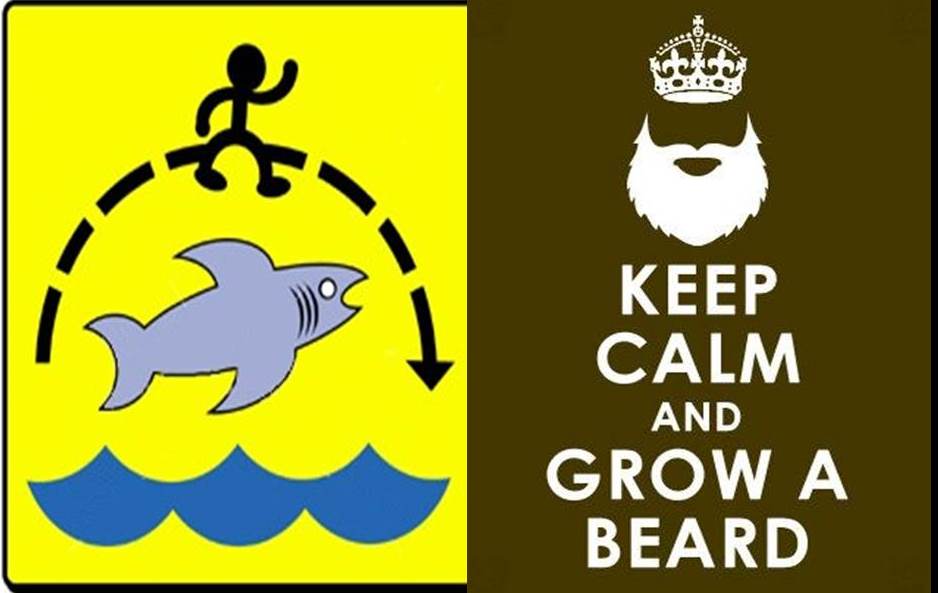
Country: Jumping the Shark and Growing the Beard?

We may look back on last week as a time when country “jumped the shark.” 

There was Pitbull (@Pitbull), Cheap Trick, Fifth Harmony and Pharrell (you could make a case for Pharrell given his collaboration with Little Big Town) on a country awards show

Then there were releases to country radio that had some programmers feeling the pop envelope had been pushed too far.

A the same time a “growing the beard” trend may also have started, rooted in conversations about the expectations of country P1s and P2s, what constitutes a balanced country playlist, and a “music line” which one crosses at their own risk.

The phrase “jump the shark” of course marks a point in time when something takes a noticeable downturn (see its origins here).

Meanwhile “growing the beard” (origins here) marks a moment of turn-around.

But before we go back down the rabbit hole of last week, perhaps we should first ask, “So what?”

The 18-49 numbers from last week’s CMT Awards Show came in with a 0.97 rating and 3.3 million viewers; and that was the combined audience on three different networks. 

This pales in comparison to both the most recent CMA Awards Show (3.8 rating,13.58 million viewers) and ACM Awards Show (2.3 rating,11.18 million viewers). 

Even May’s American Country Countdown Awards show on Fox had more eyeballs (1.0 rating, 3.8 million viewers).

But again, so what?  If a TV show disappoints the audience, that's on the television network, not on radio.

Similarly, if an artist wants to release something that we, as programmers and music curators believe in our heart of hearts is too far outside the parameters as our listeners have defined them and as we understand them, then so what? We don’t play it.

On this subject – music - listeners have given us solid guidance. 

In A&O&B's "Roadmap 2016" – our national online perceptual study of 9000-plus country radio format users - 18-54 format listeners told us that "current music from today's stars" is their preferred music cluster. 


But they've also told us to be careful with the mix - especially with music that is on the fringe.

For me, it's perfectly fine if an awards show or an artist wants to push or push past the boundaries. It's art, and art needs to be true to itself. I can choose to embrace it or not.

However there are boundaries on winning radio stations. While they may be unique across stations, they exist to help stations meet the desires and expectations of their audience.

Last week provided us multiple opportunities to thoroughly dissect, bisect, scrutinize and analyze all things country and non-country.

As we start this week, let's embrace the art and the boundaries and we'll all be helping to “grow the beard.”


Monday, June 06, 2016

Ten Take Aways from Hivio Audio Future Festival (20-Somethings and Radio? See #8)

Audience, content and platforms – notably podcasting – were some of the more frequently discussed topics at the Hivio Audio Future Festival 2016 last week (see Hivio word cloud).

Mark Ramsey Media's annual Hivio event is a “hive” of audio ideas and actions shared by people who normally wouldn’t collectively make up a typical radio convention agenda – from NPR to ESPN to content providers to podcast sellers.

Becky Brenner (@BeckyBrenner) attended the LA event in person, I watched via the online stream (thanks, Mark for providing that!).

Here are ten of our takeaways:

  1. Commercials: be relevant, funny and clever. Tell a story with a surprise. 15-second spots scored better than any other commercial length (Mark Ramsey and Novoodoo).
  2. Apply the “rat in a maze” approach – allow audience to shift platforms but keep them on your content (Howard Lapidis)
  3. The goal is to translate the best of what is happening in the talent’s life to Radio, TV and the web. Make a determination on how best to distribute content - from podcasts to building what the talent needs (Chris Balfe, Red Seat Ventures)
  4. The focus on digital has been transformative – radio is an amazing medium and we can still be vital and fabulous. Podcasting is not detracting from the Radio Listening.  It is actually growing the audience. (Anya Grundman, VP Programming and Audience Development for NPR)
  5. Rise above the noise by creating your own wave or riding waves around you. (Todd Beck, Beck Media and Marketing)
  6. Podcasts are generally too long, not “social sized,” and it is an increasingly crowded universe (1,400 new podcasts per week) David Silverman Co-Founder Clammr
  7. There is stupid money out there right now for these types of projects in video and audio. Peter Kafka, Senior Editor, Media, Re/Code
  8. I don’t have a radio at home. Radio is ancient – it is like having a laser disc – I have so many ways to listen to radio without having to have another device.  Convenient and compact is what everything needs to be, nobody wants excess baggage. (Heather, Millennial)
  9. Podcasting revenue been highly underrepresented in the press…probably $85-$100 million last year and it is going to be exponentially higher this year. Sarah Van Mosel, Chief Commercial Officer, ACAST @sarahvm
  10. Content, Content, Content.  You can’t say it enough, or focus on it enough.  It was lost in deregulation and it has to come back into focus. (Advice for radio from Traug Keller, ESPN Audio


Albright & O’Malley & Brenner’s Becky Brenner has full notes and slides in the Clients Only section of AandOandB.com.

Comments paraphrased.


Wednesday, May 25, 2016

Infographic: How to Create Amazing Content for Every Show, Every Day In Seven Steps


Facts are forgettable. Stories are sticky.

But going from that knowledge to daily creation can be challenging.

Here are seven steps to help you create and  tell a story that's both relevant and entertaining:


Try it out and let me know how it goes.

Friday, April 29, 2016

LES WAAS: MORE THAN JUST THE MISTER SOFTEE JINGLE CREATOR: His Thoughts on Today's Ads Plus Three Take-Aways For Better Creative

Like most of us in the business, you have my attention when you start talking about "creative" and about the people behind the work.

So it was predictable that I wanted to learn more about Les Waas who’s passing at 94 has been getting coverage everywhere. 

After a few hours of enjoyable research, I now know a lot more about the ad man who wrote the Mister Softee jingle in 1960.

For instance, he didn’t know how to read or write music.

That’s not only amazing for a man who wrote nearly 1000 jingles over his career, it’s courageous - even outrageous (in the best sense).

A spirit of courage and crazy-creative plays out in an interview Les did for the Pioneers of Philadelphia Broadcasting - particularly when he recounted some of his Philadelphia ad agency’s ideas and campaigns.

“I would never do anything inside the box,” he said in the interview before sharing a story about a campaign for a car dealer that increased the dealer's business fivefold (the idea involved selling the dealer’s emblem to people who didn’t buy their cars at the client’s business).

He also shared a story about a car dealer that advertised such a low price it drew a huge crowd. However that didn’t work out so well once people discovered that the price didn’t include things like the engine.

While automotive was a subject he came back to a few times, Les had thoughts about the lack of advertising creative in general and radio ads in particular.

“It took a creative brain to get into advertising…I don’t think I could do something straight. That’s writing a commercial. And a lot of that you hear now on radio is just an announcer. And they do a good job and everything, but they don’t go into creativity as much as they used to…the ads or commercials don’t seem to grab your attention. Some do…but the percentage is very small.”

While listening to Les' recollections in the interview and time traveling to the advertising world of the 60s was fun and helped to tell a great backstory about the creator of the Mister Softee jingle, obviously many of these 50 year-old campaigns are, today, appropriately curiosities.

But there were relevant take-aways from this ad man, too: 

Les' litmus test for success: If you can't remember it after the recording session then it wasn't a good ad. 

To come coming up with new ideas, surround yourself with a lot of different people.

Act immediately when creativity or inspiration strikes. “I couldn‘t hold back coming up with a creative idea. I had to do it right away.”

Being creatively courageous requires letting go of fears that could otherwise hold you back.

After all, a man who didn't know how to read or write music created more than 950 jingles.


Oh, one more thing: make sure the advertised price for a car includes the engine.


PS: As you may know, Les Waas’ Mister Softee had lyrics (lyric sheet here


For a real treat, you can hear the jingle’s creator bring them to life in the last few minutes of this YouTube video.

You can hear the produced version of the jingle in the first of these black and white TV spots here.

Saturday, April 23, 2016

Best Jobs Survey: Entertaining on the One Hand, An Opportunity for Growth, Respect and Recruitment on the Other

Not that I spend a lot of time thinking about surveys like this, but the latest CareerCast.com 2016 Jobs Report ranks “Disc Jockey” 197th out of 200 (we’ve apparently lost our bullet; in 2012 we were 180th).

Obviously if you love what you do, your job is at or near the top of your own list and no survey (other than consistently bad ratings reports or reviews if you're in radio) is likely to make you re-think your career choice.

Still, it’s interesting that many of the things that are most rewarding about being a Talent – such as competitiveness, having your work be highly visible by the public, and working in situations where you’re face-to-face with people – are seen as job negatives in the survey methodology

To compile the list, CareerCast.com uses four “Core Criteria:”

1 - Job Factors including the emotional environment. The survey sees such things as competitiveness and public contact as potential negatives. Most talent would see these as positives.

2 - Income: OK, you’ve got us there. But, show of hands please, how many of us got into performing for the money? So maybe this is only worth half the negative weight.

3 - Employment and Income growth potential: Uh, let’s move on.

4 - Stress Factors: Again the survey takes such things as Competitiveness, Travel, Working in the Public Eye, and Meeting the Public as job negatives; hopefully we all see these as things to embrace not avoid.

Also, the survey's "Disc Jockey" job description is “Broadcasts Music for Radio Stations.”

That’s pretty narrow.

Running through the rest of the 200 jobs CareerCast.com ranked, I found another 35 jobs that are (or should be) at least part of being a “Disc Jockey” including the survey's number one occupation, “Data Scientist” described as someone who “Combines information technology, statistical analysis and other disciplines to interpret trends from data.” Sounds like thoroughly breaking out ratings data to see how your show has grown.

Or how about career number 48 – “Social Media Manager” who “plans and directs online, social media presence.” Most successful talent are working hard at using Social every day.

Or Historian (61), Actor (112), PR Executive (121), Author (144) or Photographer - Instagram and Snapchat anyone? (162).

Averaging the ranks of all the jobs that are part of being a highly successful talent today would make our new rank 111. 

Adjust those aspects of the Core Criteria seen as negative to most jobs to positives in the world of talent and we'd rank higher still.

Of course no ranking should change how we feel about what we do - especially if we embrace challenge, competition, public performance, and relish the fact that our job allows us to be successful in at least 35 other jobs from Data Scientist (#1) to Advertising Sales Person (#193).

These oft unnoticed abilities we have, the work leading up to a performance, and the new growth challenges we take on and attempt to excel at daily should be a source of pride - and dare I say, be an opportunity to showcase what we do as an attractive and exciting career.

No disrespect at all to the work CareerCast.com does. In fact, their survey points out a very real truth.

If you're a Disc Jockey and all you do at your job is “Broadcast Music for Radio Stations,” then perhaps a rank of 197 is appropriate.


The last time I commented on this survey was 2012; you can read that blog here.

Thursday, April 21, 2016

New From Nielsen: The Replacements for Maximi$er and PD Advantage/Desktop


Starting this week, many programmers will be breaking out their quarterly ratings for the first time without Maximi$er.

Nielsen has just retired the legacy software along with PD Advantage Desktop and Data Express (ADE). Former Maximi$er clients will have access to PDA Light (the Max replacement) while former desktop PDA Advantage clients will have access to PDA Web.

If you are a programmer upgrading from Tapscan or E-Book only access, you’ll love the deeper dive into your numbers that you can take with these two programs.  Long-time Max/PDA users should feel comfortable fairly quickly – especially with PDA Web.

For a quick overview of what to expect, here is Nielsen’s summary of the new products: 


Besides delivery, there are several changes and additions in the online version of PD Advantage Light and PD Advantage which too has migrated from the desktop.

In both cases, station data lives online rather than being available for download (thus the automatic retirement of ADE). This means of course that users must be online to generate reports. 

Navigating the online version of PD Advantage will look very familiar to users of the desktop software. PDA Light’s navigation on the other hand is different from Max although it's intuitive – especially if you were a regular user of Maximi$er’s Programmers Package. 

Now, here’s a closer look at PDA Light and PD Advantage Web.


PDA Light

After logging in, the user is presented with a new reports screen (legacy Maximi$er on the left and the new PDA Light on the right). 

All the Maximi$er reports are in PDA Light with the exception of Report N (Total Day-To-Day Listening) and Report O (Specific Day-To-Day Listening). 

Format Norms and Top Performers (formerly a PD Advantage-only report) will be added to PDA Light later this year – a nice addition for comparing local vs. national performance.

Some of the “clunky” parts of Maximi$er have been streamlined. For example in PDA Light, demos and other report criteria can be selected using “blue links” at the top of report pages; this makes comparing demos and dayparts easier since users won’t have to leave a report screen to change parameters as in Maximi$er.

Meanwhile the process for changing base weeks is nearly identical to that in Maximi$er. And, just like in Max, you can trend up to 5 books on one screen.        

Report formats, like this for Daypart Trending, can look a bit different though the important content is nearly identical.


In another change, Diary Comments will now be released simultaneously with the quarterly data eliminating the CD delivery method. If you’ve reviewed your diaries in person, you’ll find the sorting options familiar, enabling you to quickly see your comments separate for the entire market.

With the exception of Diary Comments which date back only to fall 2015, all other data will go back 3 ½ years for trending purposes.

While it was not the most critical of the Maximi$er reports, I’ll miss report N which was an easy way to check Horizontal Cuming.  Plus, for travelers, only having access to data online will be an inconvenience.

Still, there are a number of Maximi$er upgrades that I like a lot, particularly the addition of Format Norms and Top Performers.


PD Advantage Web

For former desktop users of PD Advantage, 16 reports from the legacy version have migrated to PDA Web with some reports having new looks or additions. One of these is the Cume/TSL Report (“Grid of Pain”) which now offers multiple cume and TSL scenarios on how a specified ratings goal can be attained.

The Leading Indicators Report has a new graphing option and there’s also a new Audience Sharing report that expands on what’s in PDA Light. Also there is a newly added HD/Streaming Station report.

At this point “Workplace Zip Code” and “Mostly Spanish Breakouts” reports are presently unavailable in PDA Web though the latter is available in Tapscan.

As you go through your first analysis using the new software, feel free to call for help either in interpretation or execution. 

And of course we’d love to hear/share YOUR observations and experiences with this new software. 


Special thanks to Nielsen’s Jennifer Bratten, Manager Client Support, who provided me with a guided tour of both products, patiently answers my questions, and generously shared her slide deck so that A&O&B stations could be better informed. Also, Jennifer hosts Nielsen’s online training sessions. She’s an excellent presenter with a wealth of information on how to get the most from Nielsen’s products. Nielsen Audio clients can see and sign up for future sessions here.


Thursday, March 31, 2016

How Political Analysts Can Help Coach Talent


Fivethirtyeight.com is full of interesting content. Sports and politics of course, but also science, economics and culture (read about the Batman-Superman bromance here). 

And now, FiveThirtyEight has a coaching tip for radio.

OK, not exactly.

But their recent post about the most frequently used phrases by Presidential Candidates Hilary Clinton and Bernie Sanders got me thinking about how quantifying talents’ most oft-used subject matter – the fascinating and the irrelevant – could be a handy coaching tool.

FiveThirtyEight’s Clinton-Sanders piece uses a statistical procedure call dtf-idf which compares the frequency of words or phrases in a document, a speech, a body of speeches, etc. to their use in general.

Reading about dtf-idf was fascinating if geeky, though I was looking for a less “math-intensive” alternative to use as a coaching tool.

Enter Document Classification often used in library science to assign a piece of work to one or more categories - geography, history, science, etc.  

Subjecting a show to Document Classification could look like this:


The process can be done via an algorithm (as in text classification used for spam detection) or intellectually (manually) through user-defined criteria – the latter being perfectly fine for coaching purposes.

Plus you can quickly turn your data into a visual to help you make your point. Two shows might break out like this:


Roadmap 2016 – A&O&B’s annual client online perceptual – again confirmed listeners’ top reasons for picking one station over a competitor: plays the best music, makes me feel good when I listen, fun DJs who sound like and talk about things like my friends.

Obviously some of the bars above meet the listener criteria better than others – and that’s the point.

One of my favorite “Radio Algebra” formulae is that EV > CL – that is, the “entertainment value must be greater than the cost of listening.” The greater that differential is, the more powerful your show and station are.

A Document Classification visual can help you make that point.


Tuesday, February 16, 2016

First January Nielsens Bring Holiday Hangover Relief

The first ratings of 2016 are rolling out and - at least on the first day - it’s “thank goodness!” for Country.

While a number of formats are no doubt looking forward to a ratings period that does not include Christmas music, probably no format is more excited to turn the page than country which lost more November-Holiday audience than any other major format.

Here’s how Nielsen trended the 6+ November-Holiday book change-in-share; this includes record 6+ and 18-34 shares for AC (12.9 and 11.5 respectively) as well as a 4-year tie for highest shares 25-54 (12.1).


For country, the first 6+ PPMs that were reported Tuesday (2/16/16) were like a double dose of aspirin and prickly pear extract.

15 of the 21 measured country stations were up (5 were flat and one HD2 channel was off). 

Country, while taking the biggest November/Holiday audience ‘hit,’ is also the major format that tends to ride its January increase the longest increasing shares from the first of the year well into the summer and, last year, to September.


As I posted in an earlier blog, a number of formats see post-holiday increases that begin with a January "build."

Certainly country has challenges ahead. However history suggests that the calendar isn't one of them.

Can I get an “Amen” from country and formats that show steady growth with the start of the new year?


Friday, February 12, 2016

Need Some New Motivation? Imagine Yourself at an NFL Team Meeting

“Peer pressure is one of the greatest motivators in professional football,” former Dallas Cowboys and OU Sooners Coach Barry Switzer told the audience at the talent coaching session at this year’s Country Radio Seminar.

To make his point, Coach Switzer went on to tell the story of a particular Wednesday morning team meeting - Wednesday being the day when the entire Cowboys team would gather to watch videos of last week’s kicking game.  Everyone on the team - whether they’re part of the kicking unit or not - is present.

The video rolled and everybody watched as the individual kicking plays were shown.

It would quickly become obvious who was or was not giving their all.

As one player’s performance was called out as under-performing, Coach Switzer recalled Michael Irvin standing up and, in the presence not only of the offending player but the entire team shout, “Cut him Coach! He's going to cost us wins!"

Immediately I imagined a weekly air check meeting where everyone in the building was summoned to hear breaks from each talent’s week of shows and voice their opinions about the effort the talent was putting forth.

Knowing your work is going to be laid bare and evaluated by your teammates - not only for its in-the-moment impact, but for its positive or negative reflection on the brand and everyone associated with it now and in the future - would indeed be one heck of a motivator!

The thing is, that while we don’t generally put our on air talent through something like this (though it does give you pause), listeners do. 

And they too have a version of “Cut him, Coach!”

It goes something like: “I’m tuning out now because there must be something that's more entertaining than this.”

Hopefully we’re all aspiring to be exceptional every break (or sales call or in responding to a listener touch-point) every day. 

But a little extra motivation is never a bad thing.

Thursday, February 04, 2016

Satisfaction and Switching - Listener Hot and Cold Buttons and the Impact of Switchers


Two of the many topics we track in Roadmap – A&O&B’s annual "state of country" online perceptual study – are country listeners' 1) degree of station satisfaction and 2) switching behavior.

As we shared last year in our Pre-CRS seminar, the three-year overall satisfaction level with the country stations in our survey has been consistently high with the percent of respondents reporting they were “Very Satisfied” with their country station averaging 74%.

Playing the best music, having strong and relatable talent who sound like friends, and creating a “feel good” atmosphere have topped the list of listener satisfaction "hot-buttons" for many years running. Music quantity, local DJs, and embracing new music were other qualities that ranked in the top 1/3 of listener responses.

Among listeners who expressed some level of dissatisfaction, song repetition and too many commercials were the top two reasons (again, we’ve seen these two as the top negatives for several years).  There were also concerns over music styles, music mix/chronology, and irrelevant talk/content from the talent. 

For those who were less than satisfied, we asked - among other things - about their switching habits (if any).

Here’s a slide from last year’s Roadmap 2015 presentation of the "switched-to" destinations for 18-54s, in 2014 vs. 2015.


“Another country station” (32% up from 28%), a pure play (31% also up from 28%), and a station with a format other than country (28% up from 24%) were the top responses. 

The biggest decline was “nothing in particular” which fell from 24 to 19% suggesting perhaps that listeners may be developing a self-defined hierarchy of audio alternatives. 

Sharing/switching is an important subject to track as it can identify competitors beyond cume and QHR duplication.

In fact, switching is one of the "deep dive" subjects we'll jump into at our annual A&O&B Pre-CRS Seminar next week. 

Coleman Insights’ President and COO Warren Kurtzman and RCS and Media Monitors President and CEO Philippe Generali are the research leaders in this area they've agreed to share not only their latest intel on the switching habits of country users but - importantly -  the strategic implications of that switching, particularly the different impact a of country listener who turns your station on first vs. switches to your station from another.


The industry premiere of this country listener information is just part of our annual half-day meeting preceding CRS. This year's line up of great presenters and timely topics include:

Don Schlitz, Grammy, CMA & ACM award winning songwriter, and member of the Nashville Songwriters Association Hall of Fame will share insights on storytelling including how to find ideas and bring them to life with words.

Stephanie Friedman, VP Radio Nielsen Entertainment will reveal insights on streaming data and offer streaming strategies for radio.

Attorney Stacey Schlitz will speak on contracts, protecting intellectual property such as content, and performance rights, and other issues unique to the entertainment field – all of which are especially relevant as stations become increasingly involved with concerts.


Another highlight each year is a live, intimate performance and photo op from an emerging artist/group.

To that end we're very appreciative of the continued support of BMLG’s Republic Nashville. Last year attendees were treated to an amazing set of music from A Thousand Horses. This year year our featured artist is Republic Nashville's Brett Young


We hope you’re planning to join us Monday February 8, 2016 at the new home of the Country Radio Seminar, The Omni Downtown Nashville, from 10:30 am-1:30pm. The A&O&B Pre-CRS Seminar is free and is open to all clients as well as to broadcasters in non-competitive situations. 

You can RSVP toaobprecrs@aandoandb.com.

And, if you haven't yet registered for CRS 2016 you can do so here 
http://countryradioseminar.com/crs-2016-registration.


Monday, January 25, 2016

Rough Holiday? Nielsen and History Say You Weren't Alone


Once again the trades have been awash with news about big Holiday books for stations that went all-Christmas. 

Early on, Inside Radio reported on the impact of the over 500 stations that went all-Christmas this year: 

The Christmas format supremacy in Nielsen’s holiday ratings survey cannot be overstated, with the format ranking first in 11 of 12 PPM market reports released yesterday. Double-digit 6+ shares were the norm, as were declining ratings at non-holiday stations.  Many Santa stations doubled their December numbers and, more often than not, exceeded their Holiday 2014 performance.

Meanwhile, today, Tom Taylor at Now reported that all Christmas ruled the holiday books in 2015 and...

...broke the records for the first- and second-highest all-time high Nielsen age 6+ total-broadcast-week average-quarter-hour PPM share in any market at any time. This year AC “K103” KKCW in Portland, Oregon soared to a 21.4 share, a new all-time high in PPM. And Friday, we got the second-highest PPM share ever, Jacksonville’s WEJZ at a 19.7.
If all-Christmas wasn’t your strategy and your December or Holiday monthly looked far more like a lump of coal than a hover board, you’re not alone.

Here are five, 6+ month-by-month AQH graphs that Nielsen’s Jon Miller was kind enough to supply.


The good news for many is that your format’s peaks likely lie ahead and have at least some degree of predictability.

This allows you to get to work now on planning how you’ll capitalize on an influx of listeners in the upcoming months.